trc/The Craft

The art beneath your feet

Every rug begins long before the loom in intention, in patience, in the touch of a hand. What unfolds is not décor but a living expression of Indian craft, refined and resilient, deeply personal. To know a rug is to feel the art beneath your feet.

▸ seven stages · four to fourteen months · one loom
No. 01 — The seven stages

From a sketch on paper to a floor in Antwerp.

The journey of every rug, broken into the seven moments where decisions actually get made. None of it is fast. None of it is hidden.

01

The cartoon - the design lives on paper first.

Two to six weeks

Every rug begins as a 1:1 hand-drawn cartoon a full-scale paper template that mirrors the loom. The cartoon is read line by line by the weavers. A mistake on paper costs a week; a mistake on the loom costs a season. It is drawn in pencil first, then ink, on graph paper that approximates one knot per square. Designs travel from the head of the studio to the cartoonist, then to the weaver never the other way. The cartoon will outlive the rug. It returns to the studio archive when the loom is empty.

the cartoon roomthe cartoon room
02

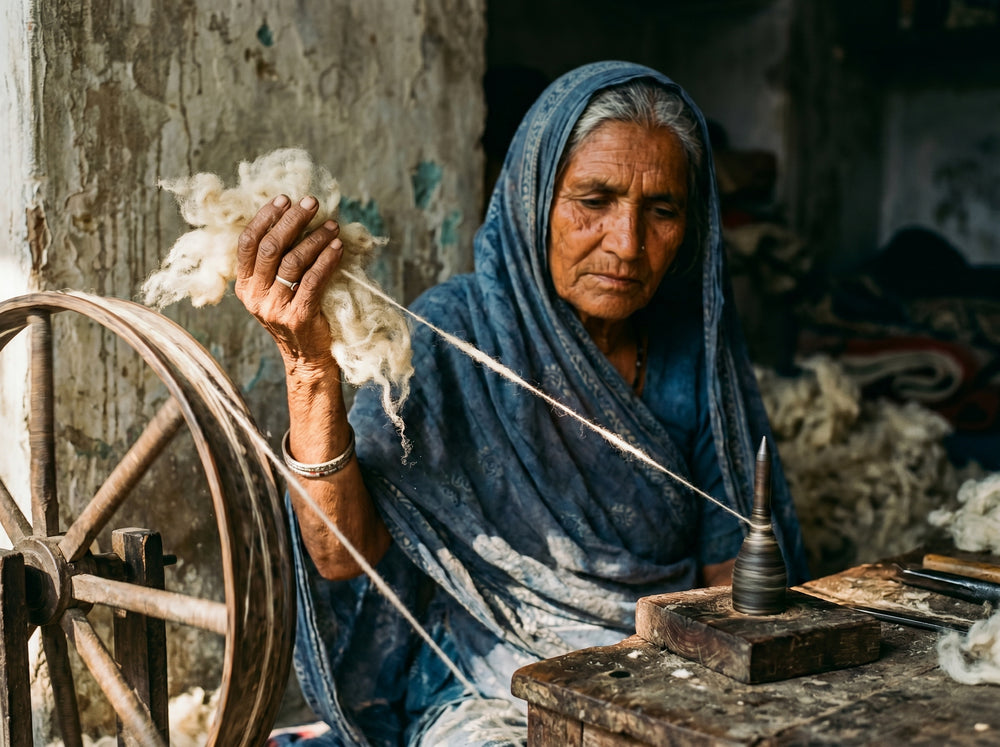
The wool - spun, washed, sorted.

Three to four weeks

Hand-spun in Jaipur, sorted by lustre and length. Only the long-staple highland fleece reaches the loom. Anything shorter is returned, with no penalty to the spinner. The fleece arrives unwashed from the highland flocks, carrying the smell of grass and woodsmoke. It is hand-carded with iron combs, then drawn into single-ply yarn on a charkha. Long staple holds the dye; short staple lets it bleed.

drying yarddrying yard
03

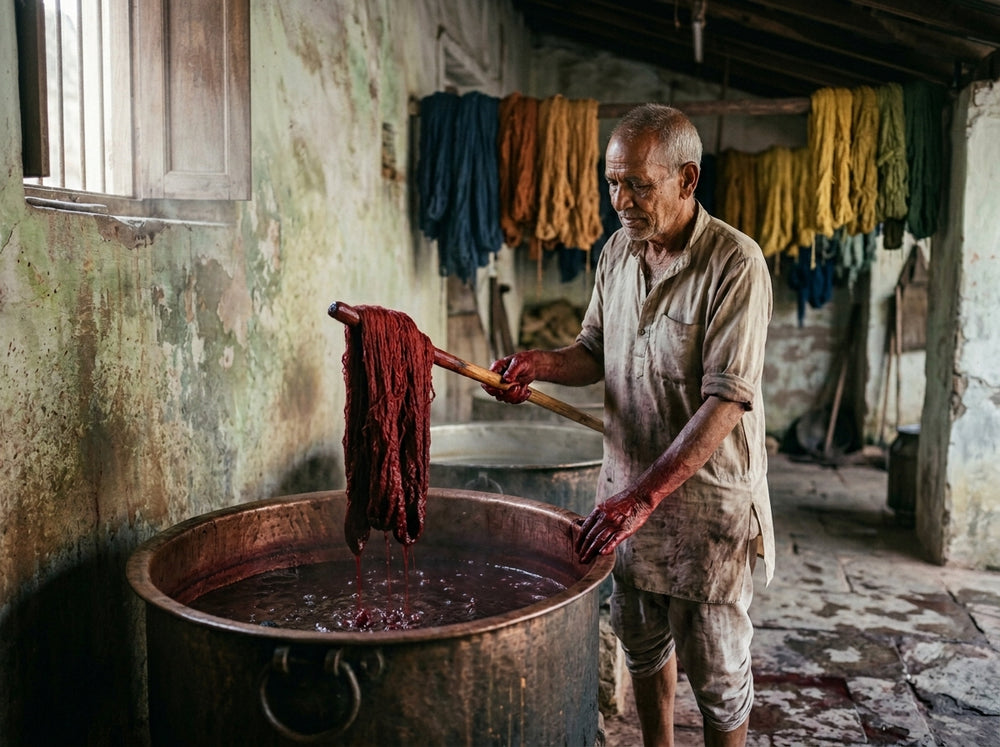
The dye - vegetable, never synthetic.

Two to three weeks

Jaipur, Rajasthan. Madder root for reds. Indigo for blues. Pomegranate skin and turmeric for yellows. Walnut hull for browns. A third-generation dyer mixes batches by eye and writes the recipe down only when he is sure. The vats are copper, blackened by years of madder. A skein is dipped four to seven times, lifted to the light between, and only released to the loom when it dries to the colour it was sketched to. Tonal variation across one dye lot is expected, never corrected it is what makes the field come alive in the rug.

the dye vatthe dye vat
04

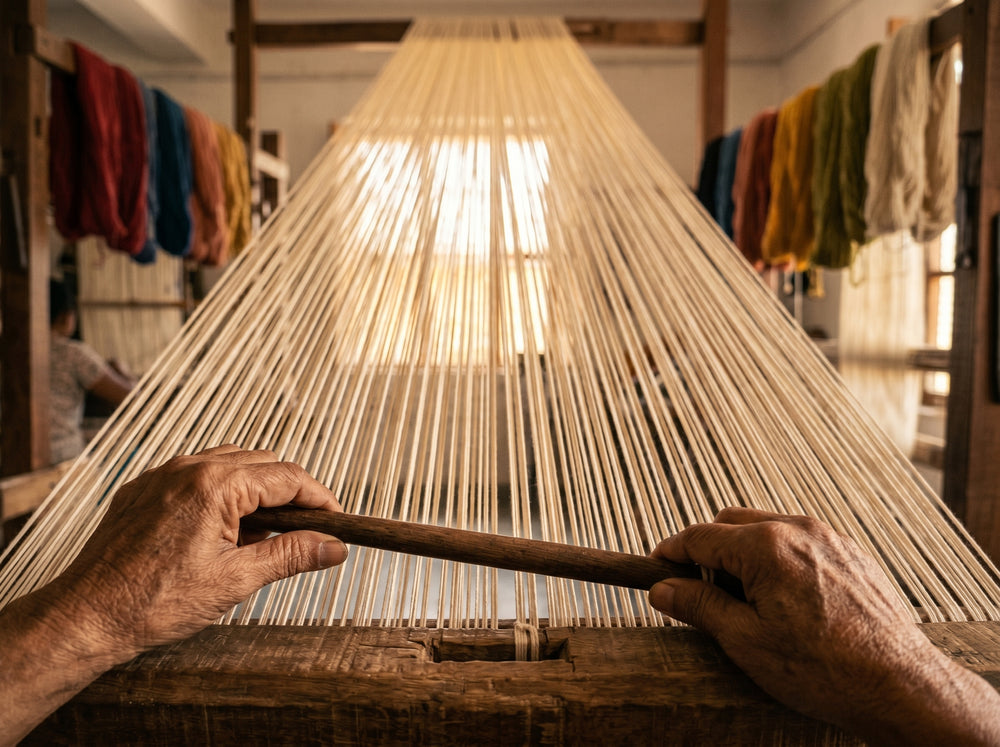
The warp - the first row.

One week

Cotton warp strung on a vertical wooden loom. The tension is set by feel a tightness that has to last the entire rug, sometimes a year. Once the first row of knots is laid, the design is committed. The cotton is mill-spun, doubled and twisted for strength, then strung in parallel rows from the upper beam to the lower. The loom itself is teak, often older than the master weaver passed between studios when one closes. Once committed, the rug can be paused but not unmade. Cutting the warp is the only way back.

warp threadingwarp threading
05

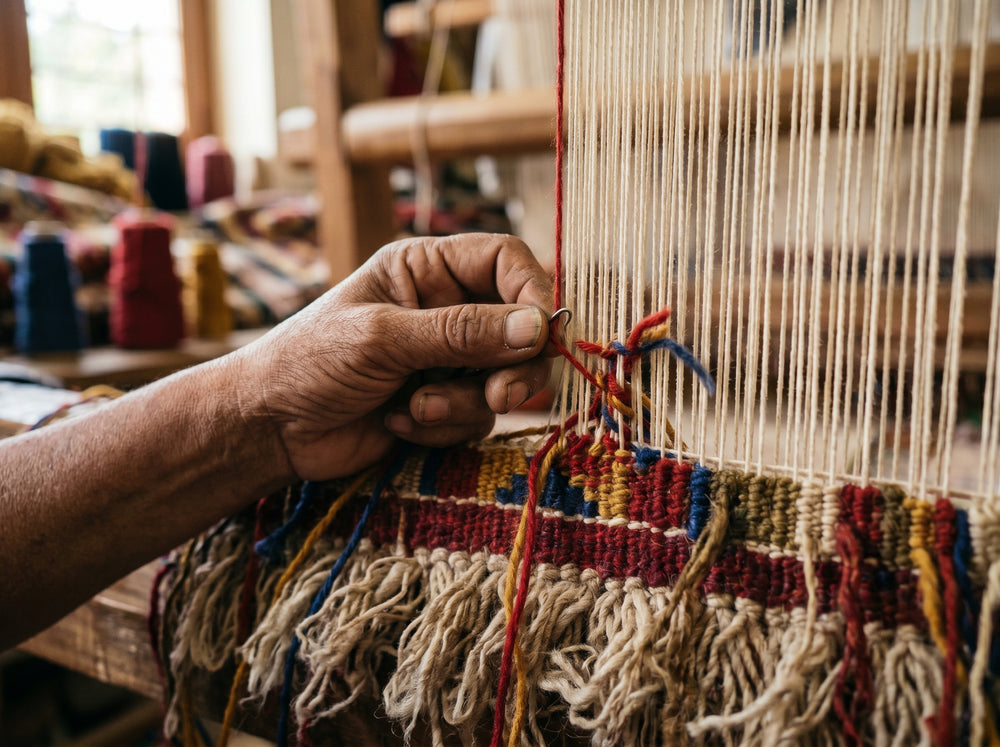
The knot — four to fourteen months.

Four to fourteen months

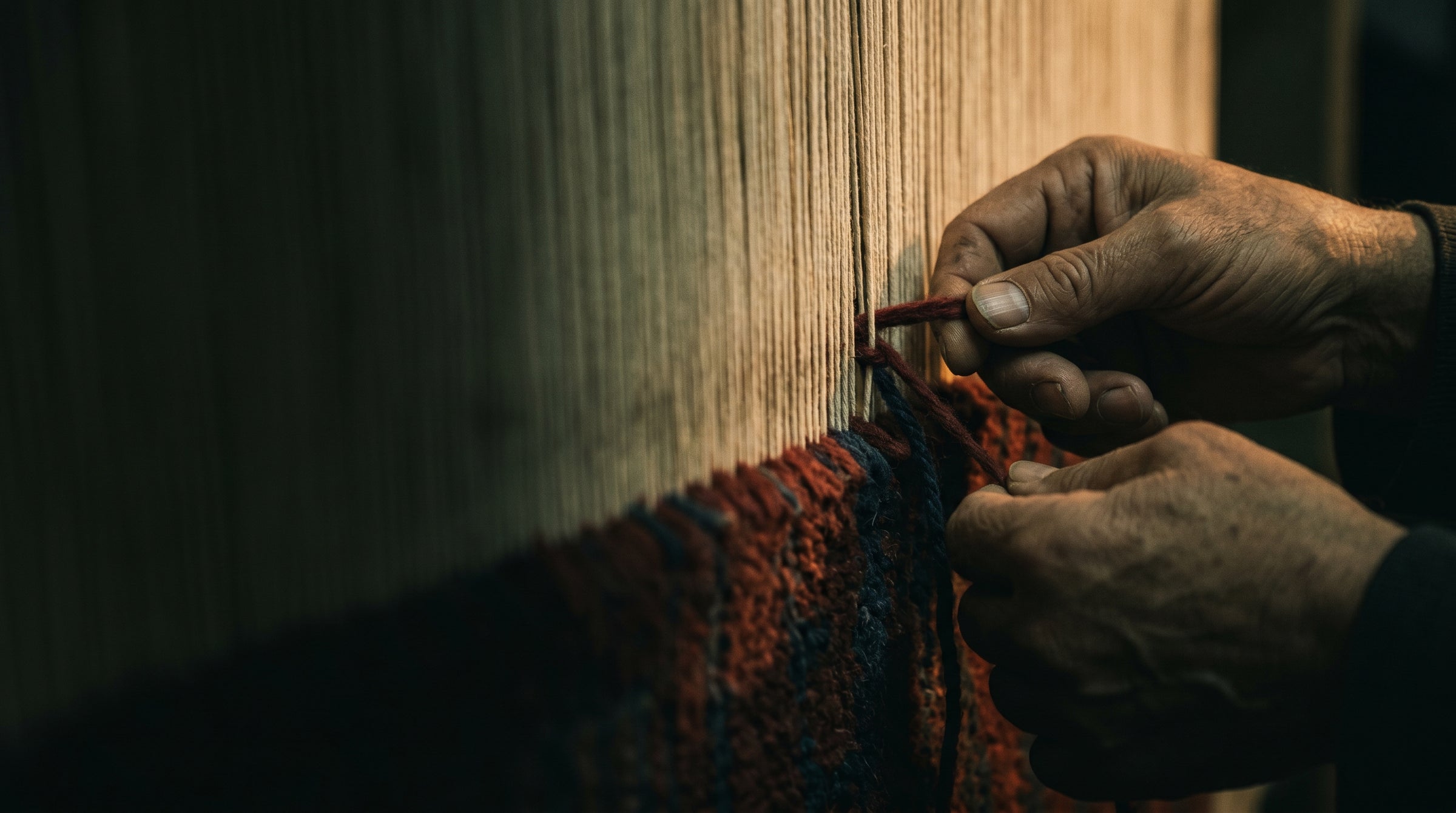
Asymmetric Persian knot, tied by hand, row by row. Between 80,000 and 200,000 knots per square metre depending on density. Two to three weavers per loom, working a six-hour day. Faster, they say, is what looms are not for. The knot is tied around two warps, looped through, and cut by a small curved blade tucked between the weaver's fingers. The cartoon hangs behind the loom; the weavers read it without looking back, counting threads by touch. A finished row is tamped down with an iron-weighted comb once a minute, sometimes twice.

weaver at loomweaver at loom
06

The wash — and the long stretch.

Two to four weeks

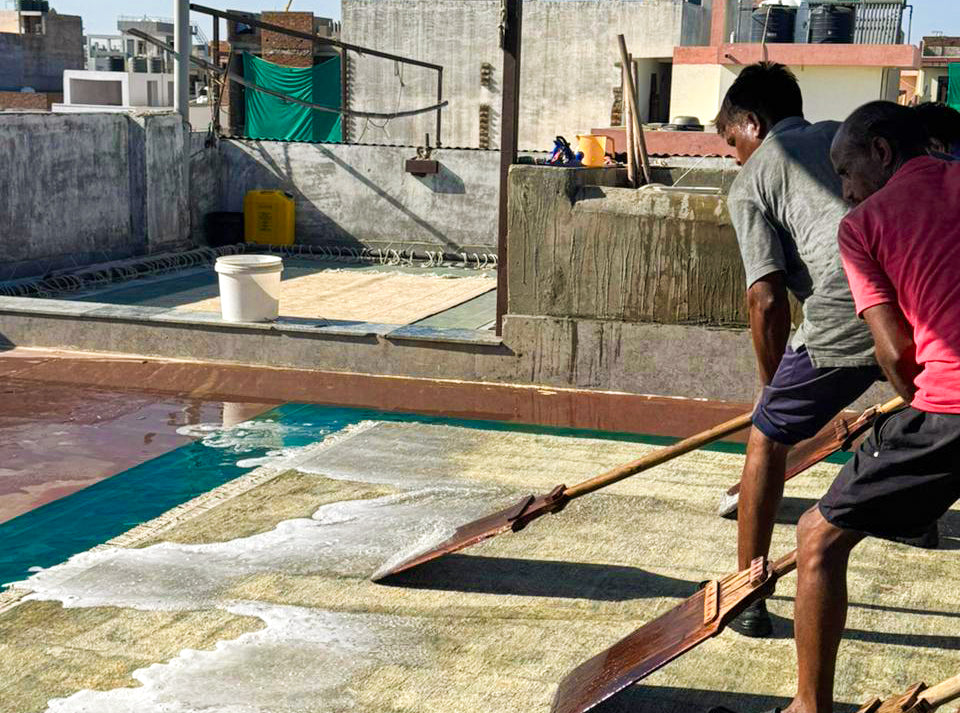
The finished rug is washed in cold water, walked on (literally) by a team of four, then stretched and dried in the sun for two to three weeks. This is where the pile finds its lustre and where flaws, if any, surface. The wash yard sits at the edge of the studio, with shallow concrete tanks fed by groundwater the colour of pale tea. The team walks the rug in concentric circles, water and wooden paddles working the soap through the pile. By the third day the rug stops shedding; by the tenth, the pile lies flat and reflects light in long bands as it dries.

wash yardwash yard
07

The finish — shearing, tassels, binding.

One week

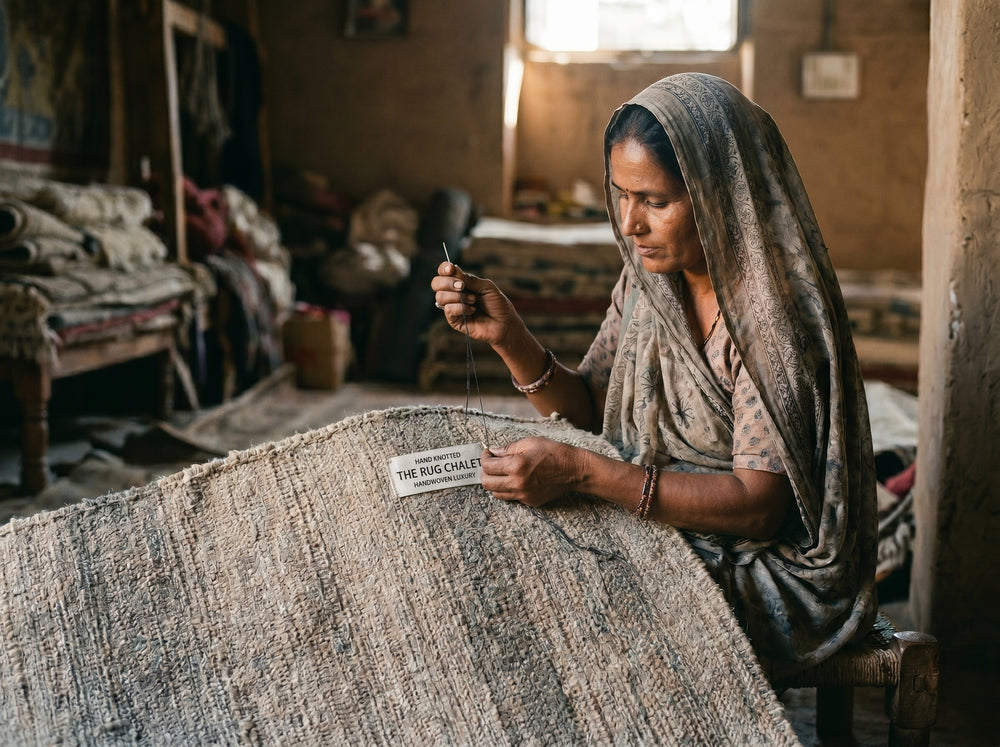
Hand-sheared to even the pile. Tassels tied by hand. Edges bound by hand. A typed object label, signed by the weaver and the studio master, is stitched into the back. The shears are heavy, two-handled, set to keep the cutting line parallel to the foundation. A pile read at angle should catch the light in a single direction, not in patches. The selvedge is overcast in matching wool, then rolled and stitched a second time so the binding hides itself. The label carries the rug's name, its knot count, the loom it was tied on, and the months it took to finish.

finishing roomfinishing room
No. 02 — Materials

Four fibres. No compromises.

The studio uses four base fibres, sourced from named suppliers we've worked with for at least two decades. No blends with synthetics. No machine-spun yarn. No bleach.

Highland Wool
Fibre · 01

Highland Wool

Hand-spun · long-staple

Wool. Hand-spun in Jaipur from highland flocks, sorted by lustre and length before it reaches the loom. Wool absorbs moisture without feeling damp and releases it without curling. It holds dye in a way no synthetic fibre can. A square metre of hand-knotted wool will outlast the room it is laid in.

Source · fleeceLustre · highHand · firmUse · pile
Silk
Fibre · 02

Silk

Mulberry silk, hand-reeled

The thread is finer than wool, and the knot count climbs with it sometimes past 400,000 per square metre. Silk does not hide variation in dye lots; it amplifies them. That is what gives a silk field its watered surface. Used sparingly in a wool ground, it draws light through the pattern in one direction.

Source · cocoonLustre · highestHand · fineUse · detail
Bamboo Silk
Fibre · 03

Bamboo Silk

Cellulose

Cellulose, regenerated from bamboo pulp. Softer than mulberry silk and less reflective quieter, easier to live with. Used where a design calls for lustre without the cost or fragility of true silk. Ages by softening rather than dulling. Bamboo Silk is considered more durable and resistant to snags.

Source · pulpLustre · quietHand · smoothUse · pile
Jute & Hemp
Fibre · 04

Jute & Hemp

Bast fibres

Drawn from the stem of the plant rather than the seed or leaf. Coarser than wool and slower to take dye, which is why we leave them in their natural tones pale hay, warm flax, the colour of dry grass at the end of summer. Used as foundation, they hold a hand-knotted pile without stretching.

Source · stemLustre · matteHand · coarseUse · foundation
No. 03 — The arithmetic of slow

One hundred and sixty-eight thousand small decisions.

Knot density is the closest a hand-knotted rug comes to a number you can measure. The denser the knot, the finer the line; the finer the line, the longer it took. There is no shortcut.

A standard TRC rug runs at 168,000 knots per square metre. The fine archive series runs closer to 250,000. The pile that holds them is hand-spun wool, mordant-dyed, beaten into place row by row.

Knot density
168k/m²
Hours per square metre
220hr
Weavers per loom
2–3
Slowest piece
14months
No. 04 — Care & Repair

A rug should outlast the room it furnishes.

i

Daily

Walk on it. Hand-knotted wool is built for footfall. The pile compacts under use and lifts again with vacuuming.

ii

Annually

Rotate 180°. Sunlight ages dye unevenly; rotation evens the patina. Beat outside in spring to lift the dust.

iii

Every 3–5 years

Professional wet wash by a hand-knotted rug specialist. Send it back to us if you prefer — we'll wash, repair, return.

iv

Every 25 years

Re-binding and corner repair. Twenty-five-year guarantee. Most TRC rugs see four or five of these cycles in a lifetime.